



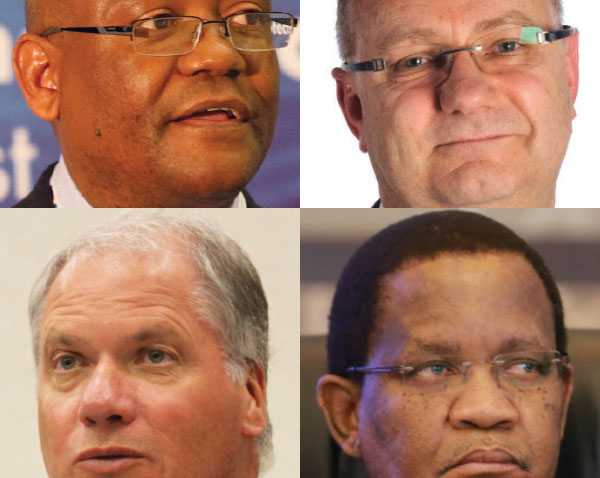

Tough 2016 for these men
Balisi Bonyongo-Debswana
Managing Director
The Debswana boss’ seat will not be a cold one this year. The company is the owner of Jwaneng mine, the world’s biggest diamond mine by value. Production at the company, which is owned by De Beers and Botswana, has been cut due to the drop in consumer demand.
Late last year, the company indicated it will put its smallest mine - Damtshaa - on care and maintenance programme for the next three years. More than 200 employees of this mine will be impacted by the closure, which has already started as of January 1st 2016.
The company said it will do all it can to keep jobs. It remains to be seen whether the company will be able to absorb all these employees within its running mines. Failure may lead to possible labour tensions, which Bonyongo will be forced to ward off. It is not clear if Bonyongo is ready to face a possible protest from Botswana Mine Workers Union whose President, Jack Tlhagale, has said they were not consulted (as stakeholders) when the mine was shut down.
“What Debswana did was improper to issue a media release and broadcast the closure of the mine without the union’s input,” Tlhagale told a weekend paper last year. Furthermore, with the diamond market taking a dip, it is not clear if the P24 billion that shareholders of Debswana have invested on Cut 8 will be able to bear the expected results based on the current weak market.
As the incumbent, Bonyongo is the right person to assure shareholders that Debswana will continue to give shareholders reasonable return on investment despite declining diamond demand. He will be forced by circumstances to paint a rosy picture even when he knows his company does not have direct control of consumer patterns and trends.
Amidst all these, Bonyongo is also under pressure to state if his company will proceed with Cut 9 that is expected to up its revenue in the coming years. In the meantime, the Debswana boss is crossing his fingers that it does not get worse before it can get any better.
Daniel Mahupela-BCL General Manager
Just when this former Debswana official was already punching the air that his multi-pronged strategy to diversify the fortunes of the copper mine is taking shape, the unpredictability of markets struck unannounced. His Selebi-Phikwe based mining company - BCL- produces copper, whose demand has dwindled on the backdrop of the commodity price crash.
Mahupela’s biggest test this year will be contending with the fact that China’s insatiable demand for copper and other metals has declined to record lows. He will be compelled to seek the next address for his copper exports. The fall in copper demand, basically spells doom for the mine which has already announced that it will venture into others minerals such as iron ore and diamonds.
The decline in commodity prices has already hit the copper industry in Botswana that is largely controlled by BCL. The result has been the dramatic fall in production. According to fresh data from Statistics Botswana, production for copper tumbled by a massive 84 percent in the third quarter of 2015.
This decline presents fresh challenges to Mahupela, who at one point late last year found himself in the unenviable position of writing his employees a memo notifying that salaries would be paid late as a result of cash flow problems. Mahupela - regarded in some quarters as the best candidate to turn around the fortunes of BCL – has no choice but to deal his ace card to tackle these latest challenges, although some are outside his sphere of control.
Mark Curtifani, Anglo American CEO
This Chief Executive of the world’s diversified mining conglomerate is facing an uphill battle this year. In the wake of the commodity crisis, the group was forced to sell some of its assets, which the group considers to be non-core.
In a bid to fight the commodity prices, the Botswana Stock Exchange (BSE) quoted company will this year begin a process of restructuring, which will lead to many job losses. It remains to be seen if Curtifani’s plan to cut jobs is the best decision that will keep the company afloat. More than 80000 jobs are on the line at the multi-billion Pula miner. Shareholders will also not receive any dividends anytime soon as they have been suspended to preserve cash.
Curtifani will certainly have a difficult job to please shareholders who demand nothing else, but reasonable return on investment from him, as per his contract. Troubles for Curtifani are coming from all sides. The diamond unit that Anglo American owns with Botswana government - De Beers - is already under siege due to poor diamond demand.
In the coming months, Curtifani, like his peers above, will be forced to justify his lucrative pay, and also to appease shareholders who have entrusted him to manage their assets, notwithstanding the poor mining market.
Phillipe Mellier-De Beers Chief Executive
This former Alstom Transport executive controls the world’s largest diamond producing company, De Beers. The year ahead will almost certainly be his toughest since he joined the company in the winter of 2011.
Chief among his myriad troubles will be how to ensure the mining giant remains a market leader despite declining consumer confidence both in the downstream and upstream diamond market. Faced with declining sales, the mining stalwart is reported to have slashed its diamond prices by as much as 9 percent last August.
This was done in a desperate bid to boost sales. However, this seems to have not worked as De Beers would later cut production by 27 percent in the third quarter of last year (Q3: 2015). With the diamond industry standing on one leg, Mellier has not been able to settle comfortably in his office. Some pundits have openly called on him to vacate the seemingly hot seat.
Days after addressing delegates in Gaborone late last year on how the country should diversify its economy, a diamond analyst and investor, Martin Rapaport called on the De Beers boss to step aside saying the industry is not save as long as Mellier is still around. “Frankly, De Beers CEO Philippe Mellier’s brand of trade exploitation and cannibalisation is no longer tolerable.
It is time for Mellier to go. If De Beers wants to survive in the diamond-distribution business, they must urgently appoint a leader who is a diamantaire,” Rapaport wrote in the Rapaport online newspaper. Rapaport is a leading diamond research and consultancy company.In Botswana, the fall in diamond market and profitability has already drifted the landlocked economy into a technical recession as it has posted negative growth in two straight quarters.
Mellier should be more worried by this as the company he heads also counts Botswana as a shareholder. Put more simply, the fall of De Beers is also the fall of Botswana’s narrowly diversified economy.
The other problem that will cause Mellier insomnia for more months to come is the hostile protests over the company’s plan to sell mines such as Kimberly mine in South Africa. National Union of Mineworkers in South Africa wants the company to halt the sale of the mine to enable further consultation.
As poor diamond sales crept in, De Beers was also forced to close one of its mines in Canada. All eyes will be on Mellier to see if the company - which traces its founding to imperialist Cecil John Rhodes - can still count itself as the alpha and omega of the diamond business, as the New Year gets underway.